Paradoxes et proximités
By Jacqueline Aubenas, 2009
Fragmented Cities: Chapter I short film
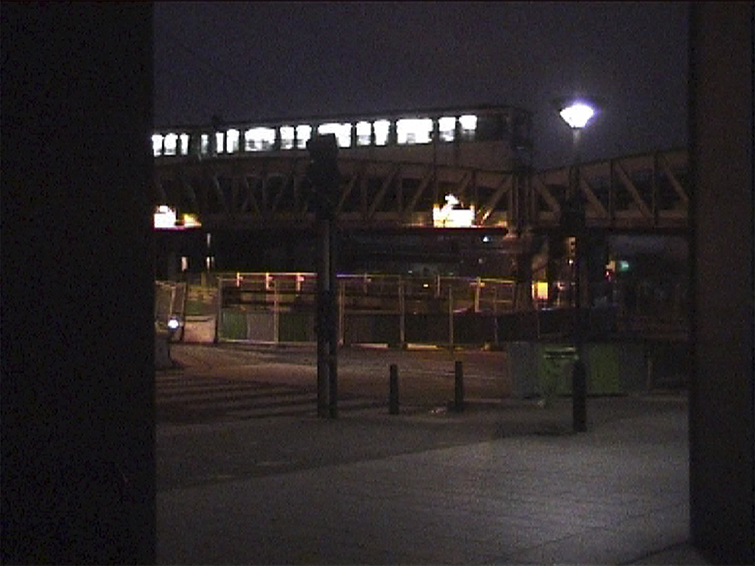
“Four cities and four sequences, named, chaptered, situated in time, variously punctuated with quotations, all announced by a few sounds and images. And, a contrario, this rigid and repetitive structure opens the way to total liberty, with simple framing, like the frame of a house, a construction for a vagrant eye to explore what each has to offer in echo or subjective resonance and which captures what each has that is unique.
“A film, like a notebook, a travel log, brief perceptions of what defines these cities, short visual phrases spliced together like a kaleidoscope, yet the ‘I’ is never spoken but, on the contrary it, too, is diffracted, dispersed among other ‘I's’, multiple voice-overs which, in the first person, get the city to speak, telling their relationship to it, spokesperson for the film-maker, fragmentary dubs.
“Apparently a ‘documentary’, a video that is founded on reality, on images of urban landscapes, houses, streets, rivers, façades, shop windows, monuments. And, surreptitiously, fiction appears, borne by fragments of stories, some developed, like in Paris, or just touched upon, slipped into the diversion of a phrase, like in Rome. Two Romanesque cities, whereas Berlin and Brussels are perceived in the brutality of their destruction, whether the historic destruction of the wall or the endless building sites that mutilate Brussels. But, there, too, reality gets turned into a story, extended and flipped through enigmatically, like a photo album, or recounted in the nostalgia for what has gone, memories of auto-fiction.
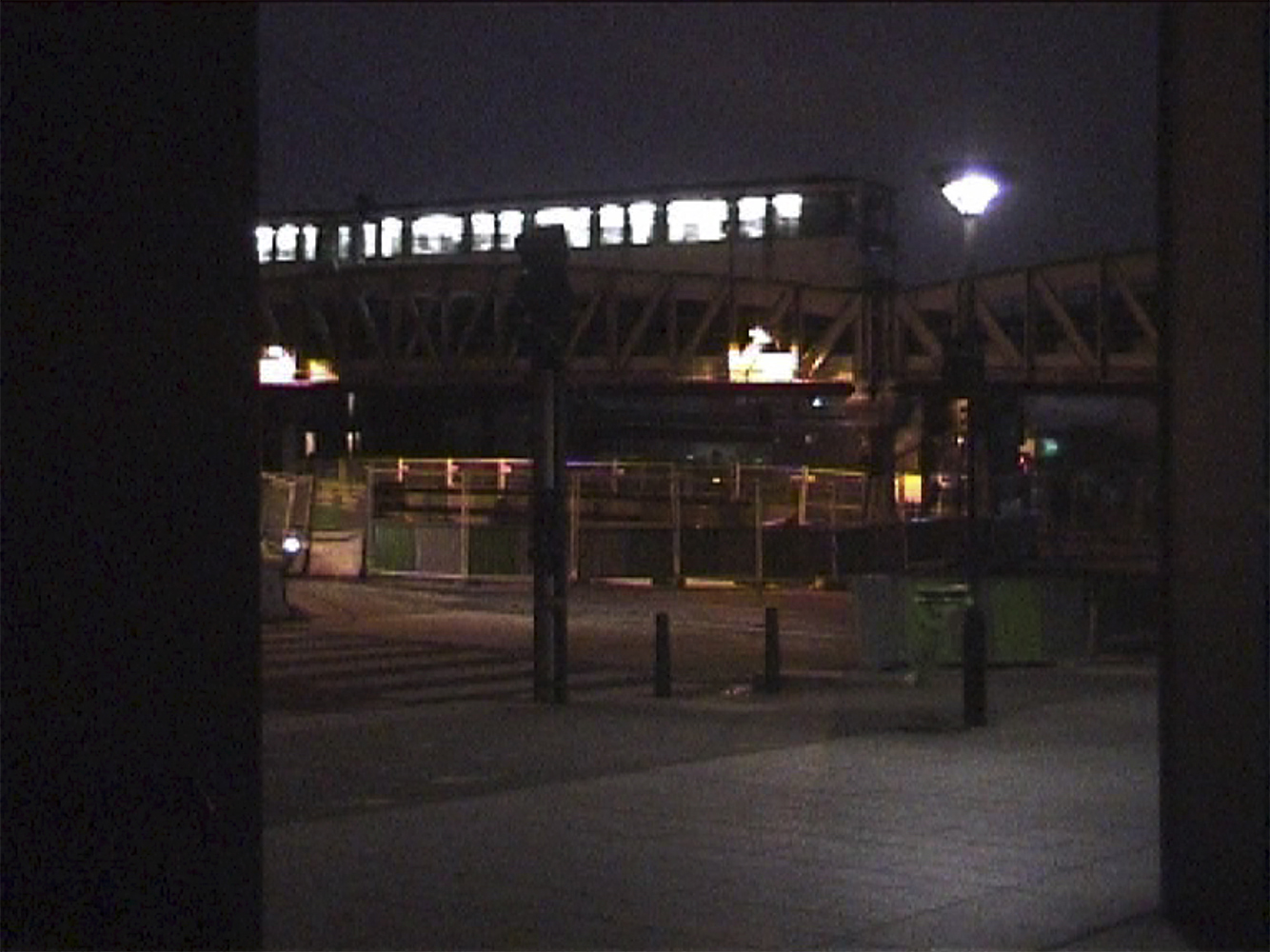
“The paradoxes, as strong as the proximities. The first, urban transport, criss-crossing all four cities, cross-rules them, discovers them in the sky or on the ground. Metros, buses, trams, lead the eye into the deliberate banality of journeys, offering glimpses, fragments of reality, scanning over the obligatory set-pieces of the postcard view. In these fragments, the feeling of something ‘generic’, that doesn't need pre-arranged, expected images. They are there, as extras, off the map, but the feeling of knowing, of recognizing, is primarily borne by sounds, by noises. The iron clang of Brussels trams, the closing doors of Paris metros, the hubbub of Roman crowds. Or a bridge, the sky, the rubble that tells geography without the need for an Eiffel Tower or Atomium.
“There is also a gathering around memory. What has happened is neither forgotten nor forgettable. It is present, in scars and traces. Whether they like it or not, the cities bear stigmata, some glorious, some shameful, some recent, some ancient. And History is just part of a network of implicit, shared connivances. We know. The film doesn't need to say much. Just, sometimes, through a sound, a voice, to recall the random arbitrariness of events, ruins or survivors.
“And bodies, or rather the absence of bodies. Faceless. The part stands for the whole. The feet and hands of anonymous commuters. Sometimes a back, a silhouette — and out of focus. The aim is not to show, to impose a person, however fleeting. This would turn them into screens, forcing the attention, even if for a second. We hear the cities, see them, in their nakedness. They are the players. They are showing themselves and Annick Blavier has seen and heard them.”
La caméra d'Annick Blavier...
By Aurélie Barre and Olivier Leplatre, 2005
Court-métrage Séduire/Seducere
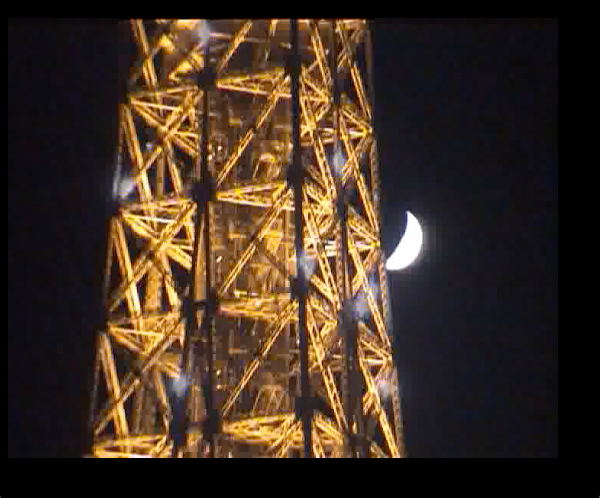
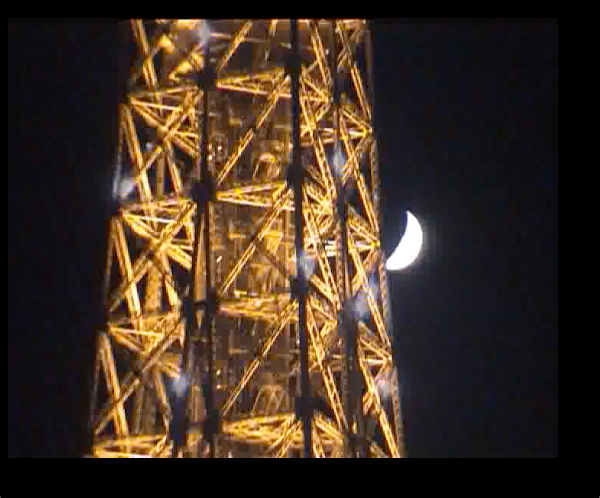
“The camera of Annick Blavier — almost still, fixed, tracking along a curved event, a chance and ephemeral meeting: in the reinvented sky, the crescent of a moon crosses behind the Eiffel Tower on an autumn night.
“We are witnesses to an act of seduction prepared on the sidelines, plotted like a gradual slide towards its moment of fullness, a spectacle splattered with sparks.
“And, although slightly to one side and far off, something else is happening, nearby, moving like barely audible breath: the story of the city as a backdrop.
“Letting oneself be transported by its slowness, so languid that it seems to have come from somewhere else, letting oneself be seduced and led astray, led by the lazy, febrile wait, the eye caught by the fan-like movement of the moon across the iron mesh.”